Faust Gallery
Jayden Starr
Western Artist · Lonesome Moon Studios
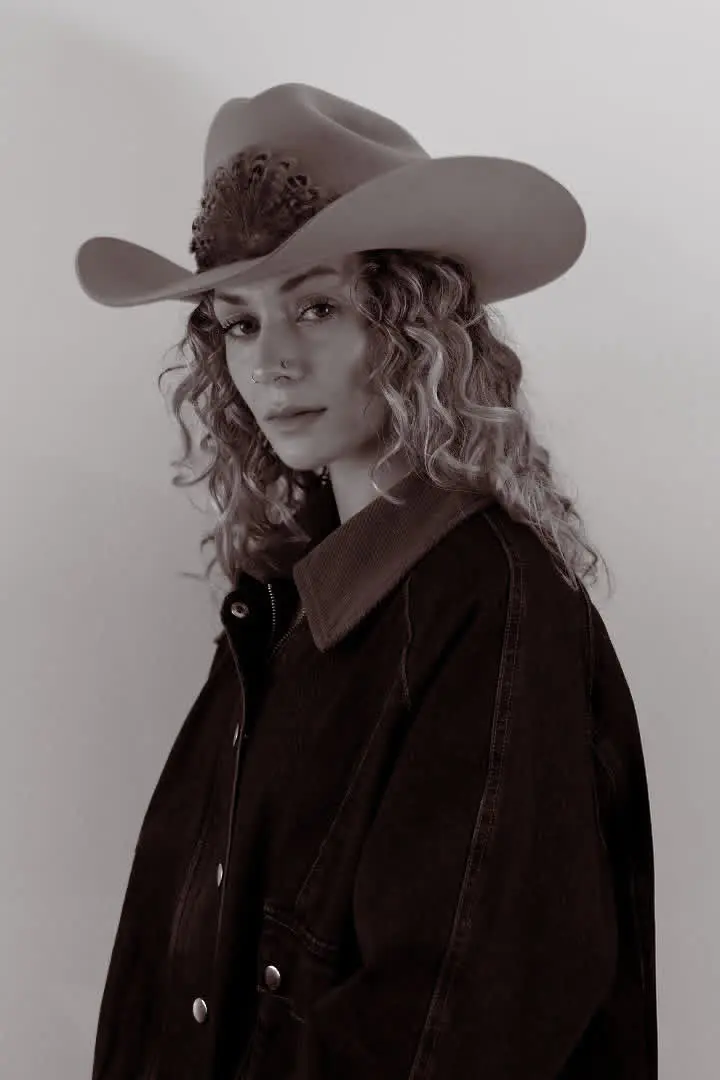
Jayden Starr is a Western artist and the founder of Lonesome Moon Studios, creating hand-painted ceramics inspired by the landscapes, wildlife, history, and visual traditions of the American West. With a BFA in Drawing, Painting, and Printmaking, Starr approaches clay as a painter, using wheel-thrown forms as a canvas for detailed imagery and layered, painterly surfaces.
Raised in Coeur d’Alene, Idaho, Starr’s connection to the West is rooted in both lived experience and an ongoing fascination with its history. Her work draws from historical photographs, vintage Americana, rodeo culture, wildlife, and the people and stories that have shaped the region.
Working across functional ceramics and one-of-a-kind fine art pieces, Starr combines traditional Western imagery with contemporary form and storytelling, creating work that reflects both the history of the West and her own experience within it. Her work was recently exhibited in the Unbridled exhibition at the A.R. Mitchell Museum of Western Art.
“Some pieces are meant to hold butter. Some are meant to hang on a wall. Some somehow end up doing both. I like that.”
Jayden Starr
Interview
Tell us a little about yourself and your work.
I’m a Western artist and the artist behind Lonesome Moon Studios. My background is in drawing, painting, and printmaking, which is what I received my BFA in. I found my way to ceramics after art school, and it quickly became this really natural meeting point between everything I loved. I could build an object, paint on it, tell a story through it, and then send it out into the world as something someone could actually live with and use.
That functionality became a really important part of the work for me. I loved the idea that a piece of art didn’t have to live solely on a wall or a pedestal—it could become part of someone’s everyday life while still carrying the same intention, storytelling, and attention to detail that I would bring to a painting.
I still work across different mediums, and I’m continuing to explore where those mediums can take me, but painting has always been at the center of what I do.
How did you get started in ceramics?
I took a ceramics class at a local art center in 2024 and pretty quickly became obsessed with it. At the time, I was working in a stressful career outside of the art world, but art kept calling me back. Ceramics became a way for me to reconnect with that part of myself and, eventually, to find my way back to being an artist full-time.
Because I already had such a strong background in painting, I started treating the surfaces of my pots like canvases almost immediately. I was less interested in separating painting from ceramics and more interested in seeing what could happen when I brought the two together. That combination of painting, form, and functionality ultimately became the foundation for Lonesome Moon Studios and continues to shape the way I work today.
Why the American West?
The West has always felt like home to me. I grew up in Idaho surrounded by mountains, wildlife, and people connected to Western life—cattle ranchers, barrel racers, horse trainers—and my grandmother put me on a horse when I was very young.
I think I understood just how deeply connected I was to the West when I moved away. Living on the East Coast created this persistent longing for home that naturally began finding its way into my work.
Over time, that connection grew into a fascination with Western history and the real people, events, traditions, and stories behind it. I love digging through old photographs, historical accounts, vintage advertisements, and Western imagery and finding ways to interpret them through my own work.
In a lot of ways, making Western art began as a way of returning home when I couldn’t physically be there. Now, it’s become a way of continually rediscovering it.
Where do you find inspiration?
My inspiration really began with my upbringing in Coeur d’Alene and the people I was surrounded by. I noticed early on that there was a certain grit to the people working in Western industries that I couldn’t ignore. Their stories were always richer and more complicated than what you might assume from a job title like rancher, horse trainer, or rodeo athlete.
The relationship between people and animals is also essential to my work. I’ve always had a strong connection to animals myself, so I’m naturally drawn to the partnership and trust that exists between the two.
From there, curiosity took over. I began diving into historical photographs and stories of figures who helped shape the American West, while also connecting with people who are carrying those traditions forward today.
Ultimately, experience is my greatest source of inspiration. Traveling, meeting people, hearing their stories, and experiencing a place firsthand gives me something I could never find by simply looking at an image.
How would you describe your artistic style?
Illustrative, narrative, and a little nostalgic. I love work that feels like it could have existed decades ago without simply reproducing something old. One of my biggest goals is to tell stories that people can connect with in different ways based on their own experiences. There’s often a balance in my work between traditional Western imagery and a more contemporary approach to storytelling and form.
Functionality adds another layer to that storytelling for me. A pitcher can carry a painting. A plate can tell a story. When someone actually uses that piece, the artwork becomes part of their everyday life and takes on new memories and meaning along the way.
I love taking familiar forms and using their surfaces in unexpected ways. There’s something really special to me about making an object that can tell a story while also becoming part of someone else’s.
What does your process look like?
Most pieces begin with research, an experience, or an image I can’t stop thinking about. From there, I’ll sketch, work through the composition, and consider what ceramic form makes the most sense for the story.
For example, I once happened upon two elk fighting in Colorado. It was such a powerful experience that I knew almost immediately the image would continue to find its way into my work.
I primarily work with wheel-thrown stoneware, painting directly onto the clay with underglaze. The paintings can become incredibly detailed and often take much longer than making the form itself. After firing, I use glaze to build additional depth and texture.
There are so many opportunities for a piece to change throughout the ceramic process, which gives the process room to breathe. I can control the painting, but I have to leave a little room for what is meant to be.
Your work includes both functional pottery and fine-art pieces. How do you see the relationship between the two?
For me, function and fine art can absolutely coexist. When you see a piece of art you love, you form a connection to it through your own lived experience. Functional work can carry that same connection while adding another layer—you actually live with it.
I love the idea of creating something that might eventually become part of someone’s family history. A painting can be passed down through generations, but so can a plate or a pitcher. Over time, the object carries not only the artwork, but the memories attached to it.
I don’t really see a hard line between the two. Some pieces are meant to hold butter. Some are meant to hang on a wall. Some somehow end up doing both. I like that.
What are you most interested in exploring in your work right now?
Storytelling. I’m spending much more time researching the subjects I paint and looking for stories from Western history that I can translate through my work. There are so many historical and modern-day stories waiting to be told—stories that have shaped the West we know today and help explain why so many of us continue to feel connected to it.
I’m also allowing myself to move beyond ceramics when an idea calls for it. My background is in painting, drawing, and printmaking, and I’ve never stopped thinking like a painter. I’m excited to see Lonesome Moon continue to expand across mediums while still maintaining a visual language that feels distinctly my own.
What do you hope someone feels when they encounter your work?
I hope there’s an immediate sense of familiarity or nostalgia, even if someone can’t quite identify why. I want the work to connect with something in their own memories or experiences and then invite them to look a little closer.
There might be a historical reference they didn’t recognize at first, an animal tucked into a landscape, or a detail in the painting that only becomes apparent when they’re holding the piece. I love artwork that rewards spending time with it.
More than anything, I hope the work creates a connection. The story may begin with me, but I love that once a piece leaves my hands, someone else brings their own experiences and meaning to it.
What does Western art mean to you?
To me, Western art is this enormous visual and cultural conversation about land, people, animals, work, mythology, history, and identity. It’s an accumulation of different interpretations of ideas, events, philosophies, and traditions, with each artist bringing something of themselves to that conversation.
That’s what makes Western art so interesting to me. There’s this constant meeting of old and new—stories and traditions that have existed for generations being interpreted again through a different set of eyes.
Having grown up in the West, there’s also something deeply personal about it for me. I can almost always find something in Western art that connects me back to my roots, and I think that’s beautiful.
What’s next for you and Lonesome Moon Studios?
I’m continuing to push the work toward more ambitious, research-driven pieces while still making the functional ceramics that Lonesome Moon was built around. I’m especially interested in larger statement pieces, historical narratives, and work that moves between ceramic and fine-art spaces.
I want to keep pushing what I can achieve through ceramics and painting—experimenting with form, scale, sculpture, and storytelling while allowing the work to evolve naturally. More than anything, I get excited thinking about the next story I might uncover and finding my own way to retell it.