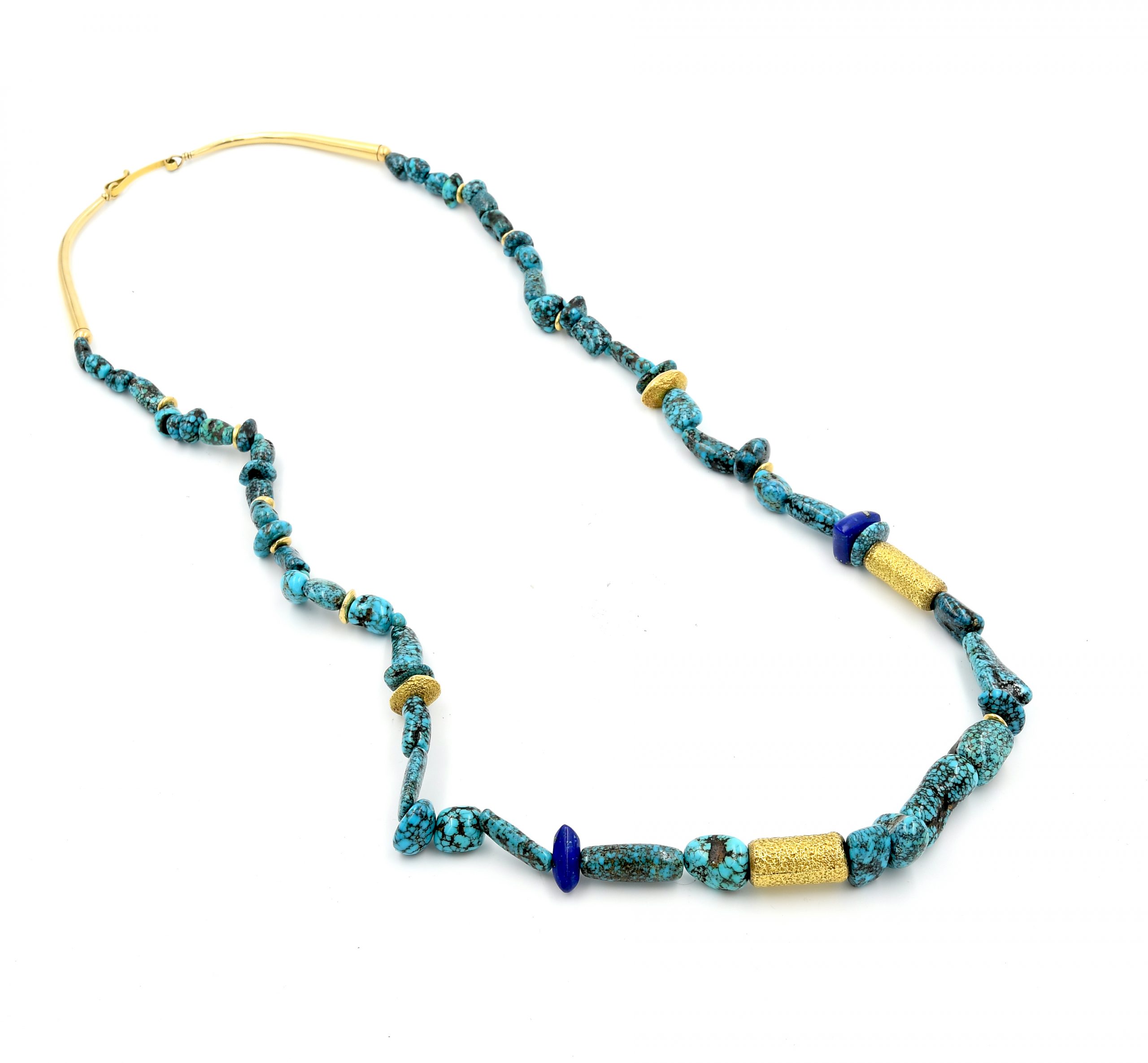
Charles Loloma Lone Mountain Fossil Necklace

$325,000.00

Lone Mountain Fossil Turquoise is the rare turquoise stones on earth. Charles Loloma crested this necklace in 1985, and today it reminds one of the most important pics he ever created. Being one of them of the most thought after turquoise specimens, this would be the crown jewel of your collection.

Dimensions: 34″ L

In Stock

Categories: ,
Artist:

Charles Loloma

b. 1921, Hotevilla, Arizona  ·  d. 1991  ·  Hopi

Hopi master jeweler Charles Loloma at his studio bench

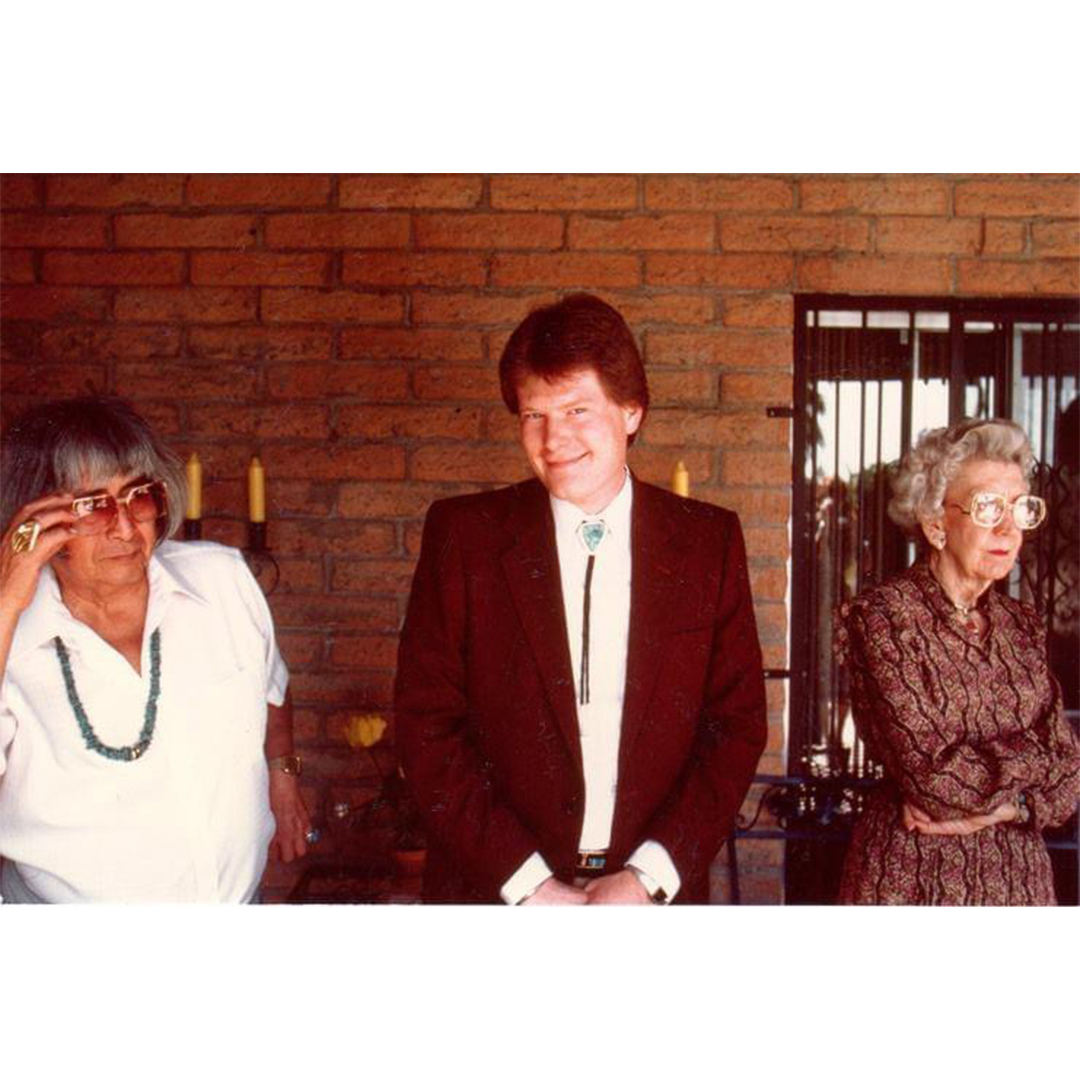
Charles Loloma, William Faust II, Lovena Ohl.

Widely regarded as the foremost Native American jeweler of the twentieth century, Charles Loloma transformed Hopi jewelry by introducing gold, diamonds, and unconventional stones, and by setting hidden "inner gems" within his pieces. A member of the Badger Clan and a Hopi spiritual leader, he drew on a deep reverence for his heritage to create work that entered collections around the world—from Mrs. Dwight D. Eisenhower to the Queen of Denmark.

"In order to create valid art, you have to be true to yourself and your heritage."

— Charles Loloma

In 2005, the Wheelwright Museum in Santa Fe honored Loloma with a 466-object retrospective titled Loloma: Beauty Is His Name—a fitting title, since "Loloma" means "beauty" in the Hopi language. Asked what he hoped to be remembered for, he simply said: "beauty."

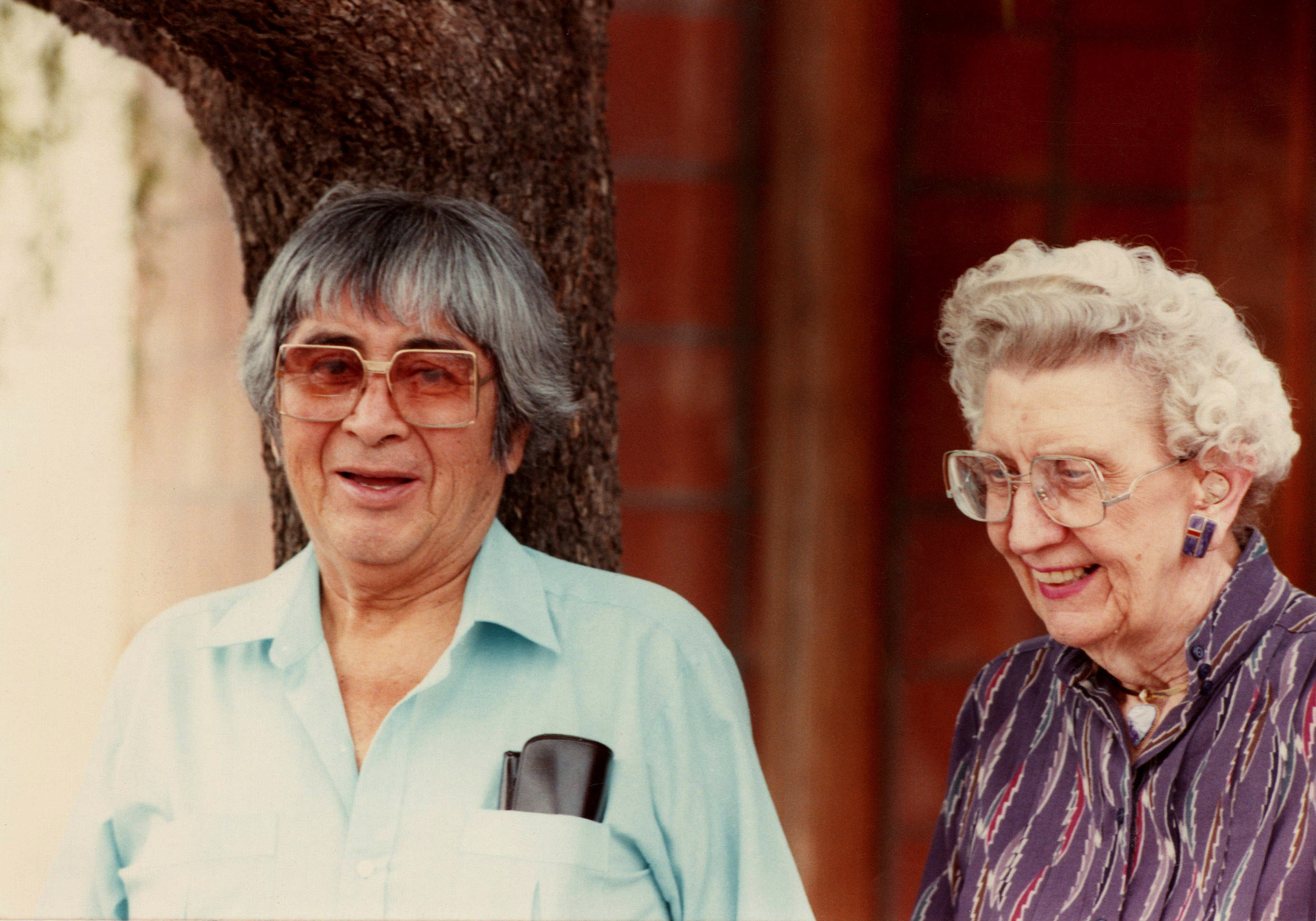
Hopi jeweler Charles Loloma with gallery owner Lovena Ohl, 1987

Lovena and Charles Loloma, 1987

The Significance of Turquoise
Turquoise is one of the most culturally important and visually celebrated stones in Native American jewelry. Valued for its protective qualities, spiritual symbolism, and natural beauty, turquoise has been used in adornment, trade, and ceremony for thousands of years.

Across the American Southwest—particularly in Nevada, Arizona, and New Mexico—turquoise mining has yielded some of the finest specimens known. Among these, Lone Mountain Turquoise stands out for its brilliant color, fine matrix, and stability. Even rarer is the formation known as Fossilized Turquoise, in which the gemstone replaces organic matter—an occurrence both scientifically and visually remarkable.

Fossilized Lone Mountain Turquoise
The turquoise featured in this necklace is not only beautiful but also paleontologically rare. These stones formed within crinoid fossils, ancient marine animals that lived during the Pennsylvanian Period, roughly 298 to 323 million years ago. Over millennia, calcite within the segmented stems of crinoids was gradually replaced by turquoise—a rare geological transformation that left behind fossilized turquoise bearing the distinct imprint of prehistoric life.

This type of formation is exceedingly uncommon. Unlike most turquoise, which forms in host rock, fossil turquoise grows in place of ancient biological material. It is incredibly rare to find enough matching fossil segments to create a full strand—making this necklace a true masterwork of natural history and human artistry.

Tufa casting is an ancient and revered metalworking technique used predominantly by Navajo and other Southwestern Native American jewelers. The process involves carving a design into a soft, porous volcanic stone known as tufa, which is composed of compressed volcanic ash. Tufa stone is ideal for casting due to its ease of carving and ability to withstand high temperatures.

To begin, the artist cuts and sands two matching tufa stones, creating a mold by hand-carving the desired design into one half. A funnel-like channel is also carved to allow molten metal—usually sterling silver or gold—to be poured into the mold. The two stone halves are then bound together and pre-heated to remove moisture, which prevents cracking during casting. Once the molten metal is poured in and cooled, the mold is broken open, revealing a one-of-a-kind piece.

Tufa casting is prized for its texture—the stone imparts a natural, grainy surface to the metal, giving the finished jewelry a distinct organic look and feel. Many artists embrace this texture as a signature element of their work, often finishing the piece with additional hand stamping, polishing, or stone inlay.

This method allows for artistic freedom and individuality, as each mold is used only once, making every tufa cast piece truly unique. Tufa casting reflects a deep respect for tradition and craftsmanship, preserving a hands-on, ancestral approach to jewelry making that continues to inspire contemporary Native artists today.

Necklace Length Guide – Find the Right Fit for Your Look

When selecting a necklace, the length makes all the difference in how it feels, looks, and layers. Whether you’re purchasing a fine inlay pendant or a hand-fabricated gold chain, this guide will help you choose the ideal necklace length for your body and style.


Standard Necklace Lengths for Adults

Length Name Where it falls Best For
14″ Choker Tight around the neck High-neck outfits, layering, bold statement
16″ Collar Base of the neck Everyday wear, delicate pendants
18″ Princess Sits at collarbone Classic choice, suits most necklines
20″ Matinee Just below collarbone Slightly longer pendants, high necklines
22–24″ Opera Above bust or mid-chest Statement pendants, layering
30–36″ Rope or Lariat Drapes below the bust Elegant evening wear, versatile wrap styling

Tip: Use a string and ruler to test different lengths before ordering.


Necklace Length Guide for Women

  • 16–18″ is the most popular length for everyday wear.

  • 20–24″ works well for longer pendants or statement pieces.

  • For a more dramatic look or layering, 30”+ lariats can be styled doubled or knotted.


Necklace Length Guide for Men

  • 18″ fits closely around the neck.

  • 20″ falls at the collarbone and is the most common men’s length.

  • 22–24″ offers a relaxed fit for pendants or heavier pieces.


Tips Based on Body Type and Face Shape

  • Petite frames: 16–18″ helps elongate the neck and keeps proportions balanced.

  • Broad shoulders or larger chest: Consider 20–24″ for a comfortable fit.

  • Round or square faces: Longer necklaces (20” and up) help create a more elongated appearance.

  • Oval faces: Almost any necklace length will complement this shape.


Pairing Lengths with Jewelry Styles

At Faust Gallery, many pieces are one-of-a-kind and deserve to be showcased at the perfect length:

  • Inlay pendants or large stones: Opt for 18–22″ to center the piece on the chest.

  • Gold and silver chains: Use 16–20″ for layering or 24″+ for a longer, refined look.

  • Artist-made lariats or figure pendants: Let them shine with 30″+ lengths, styled simply.


Necklace Fit and Styling Tips

  • Measure where you want the pendant or focal point to rest.

  • Consider the weight of the piece—heavier pendants hang lower.

  • Handmade or artist-signed closures may add extra length to the total chain.

  • Try on with the neckline you plan to wear it with for the most accurate look.


Need Help Choosing the Right Length?

We’re here to help you make the perfect selection.

  • Email us at sales@faustgallery.com

  • Visit us in person at our Scottsdale, AZ or Santa Fe, NM galleries

  • Request a photo or video of how the necklace hangs on a bust or model


Custom Chain Lengths Available

Some pieces can be adjusted to suit your preferred length. Contact us before purchasing—we’ll work with the artist when possible to ensure your necklace is tailored to fit your vision.

Lone Mountain Turquoise, mined in Esmeralda County near Tonopah, Nevada, is one of the most admired and collectible turquoise varieties in the American Southwest. Known for its intense sky‑blue to robin’s egg hues and signature black or brown spiderweb matrix, Lone Mountain has earned its place among the finest turquoise in the world.


A Brief History of Lone Mountain Turquoise

Originally known as the Blue Jay Mine, turquoise was first discovered at Lone Mountain in the 1920s by miner Lee Hand. It gained national recognition in the 1960s, with major production driven by Menliss Winfield and later Gene Waddell, who helped elevate the mine’s reputation through high-grade output.

In 2015, ownership transferred to the Smith family, who continue to mine the site in limited quantities. Lone Mountain remains one of the few American turquoise mines still producing, but its natural, untreated high-grade material is extremely rare and increasingly coveted.


What Makes Lone Mountain Turquoise Unique?

  • Color: Vivid sky-blue to robin’s egg blue tones
  • Matrix: Known for its tight spiderweb matrix in black, brown, or grey
  • Hardness: Naturally hard and typically untreated
  • Variety: Includes spiderweb, water-web, clear blue, and even fossilized turquoise
  • Legacy: Used by iconic Native artists including Charles Loloma, Mark Chee, and Lee Yazzie

Lone Mountain’s spiderweb material is considered second only to Lander Blue in desirability, with its crisp matrix and brilliant color elevating it above most turquoise types on the market.


Why Collectors Love Lone Mountain Turquoise

Collectors and jewelers value Lone Mountain turquoise for its durability, beauty, and rarity. Unlike most turquoise that requires stabilization, high-grade Lone Mountain stones are often entirely natural, which greatly enhances their value. The distinct spiderweb matrix makes each stone visually unique, and its proven track record in both vintage and modern fine jewelry has made it a cornerstone in turquoise collections.

As availability continues to decline, Lone Mountain turquoise remains one of the most treasured materials in the world of Southwestern jewelry.


Summary

Feature Details
Origin Lone Mountain Mine, Tonopah, Nevada
Discovery 1920 by Lee Hand; originally called Blue Jay Mine
Mining History Major output in the 1960s–1980s; limited today
Color Range Sky‑blue to robin’s egg blue
Matrix Tight spiderweb in black, brown, or grey
Hardness Naturally hard; often untreated
Varieties Spiderweb, water‑web, clear blue, fossil turquoise
Availability Scarce; high-grade material is rare
Collectibility Highly valued by collectors and jewelers