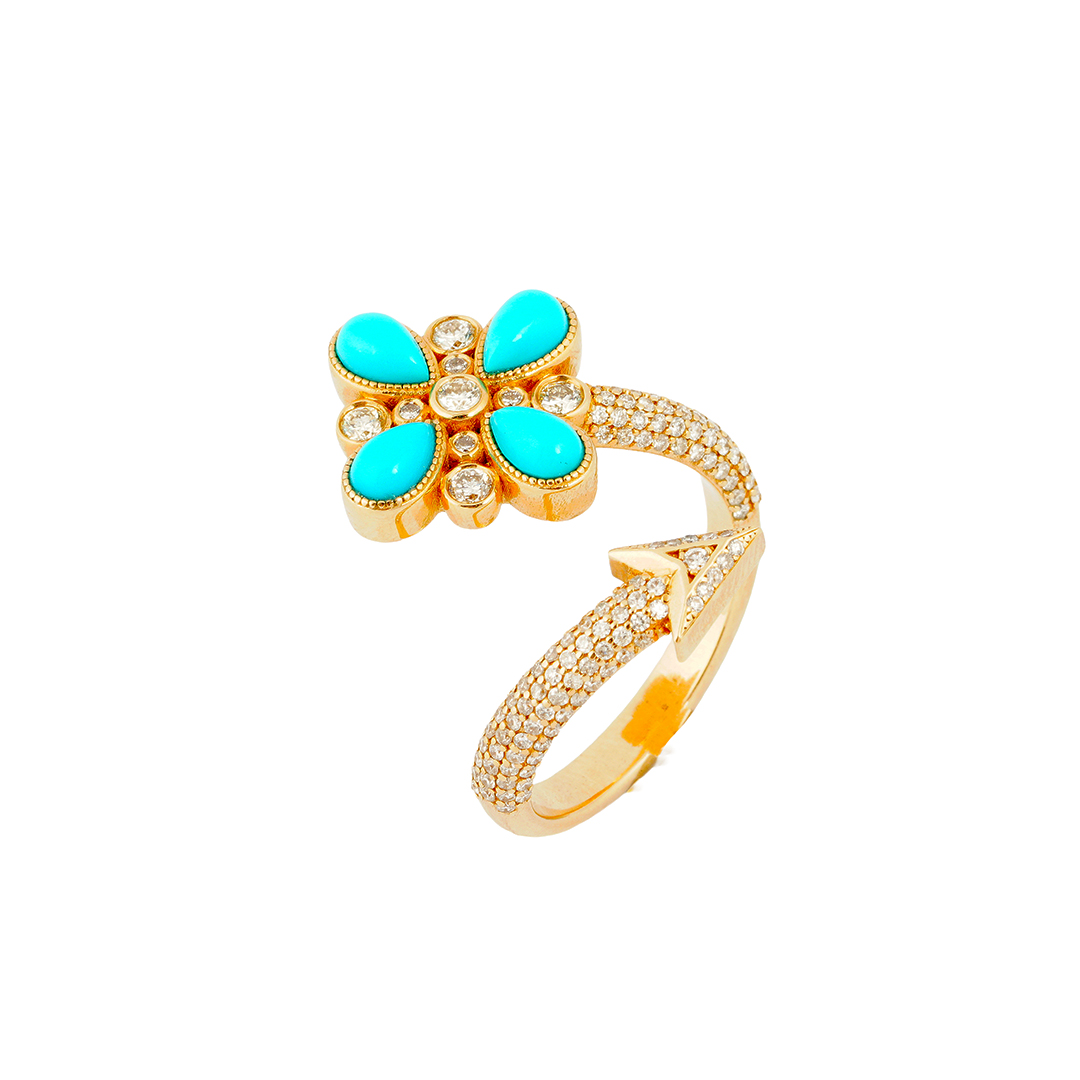
Hamdouni, Mia Zaara 14k Gold Ring “Arrow Bloom”

$4,500.00

Arrow Bloom Ring

The Arrow Bloom Ring is a turquoise arrow ring by Navajo designer Mia Zaara Hamdouni. On one side of this open 14k gold ring, petals of Sleeping Beauty turquoise form a small desert bloom. Diamonds trace the design, and the arrow carries it forward. As a result, the ring pairs a soft floral form with the clean line of an arrow.

Metal — 14k yellow gold

Stones — Sleeping Beauty turquoise and diamonds

Diamonds — 1.54 ct total weight, G–H color, VS1 clarity

Band Width — 2 mm

Ring Size — 7

A Turquoise Arrow Ring with Meaning

Mia draws on two symbols here. First, the bloom recalls the wildflowers that open across the desert after rain. Second, the arrow stands for protection and for moving forward with purpose. Together, they give the ring a quiet strength. In short, it is a ring to wear every day, not one to save for special occasions.

Because the band is only 2 millimeters wide, the design stays light and comfortable. In addition, the open shape lets the bloom and the arrow sit side by side on the finger. As a result, this turquoise arrow ring works well on its own, and it also stacks easily with other rings. For example, it pairs naturally with a plain gold band or a slim diamond ring.

Sleeping Beauty Turquoise and Diamonds

Sleeping Beauty turquoise comes from the Sleeping Beauty Mine near Globe, Arizona. Collectors prize it for its clear, even sky-blue color with little or no matrix. However, the mine stopped producing turquoise in 2012, so fine stones like these are increasingly scarce. Next to white diamonds and warm 14k gold, that bright blue stands out even more.

Meanwhile, the diamonds total 1.54 carats, with G–H color and VS1 clarity. In other words, they look bright and white, and any inclusions are very difficult to see.

In Stock

Mia Zaara Hamdouni · Navajo & Tunisian

Fine Jewelry Designer  ·  Santa Fe

Mia Zaara Hamdouni is an enrolled member of the Navajo Nation and of Tunisian descent. Her jewelry draws on both sides of that heritage—Navajo tradition, Mediterranean design, and the desert landscapes they share.

Jewelry runs in her family. Her great-grandfather was a respected Navajo community leader, medicine man, and silversmith. She learned design from her mother, a jewelry designer who ran a shop in downtown Santa Fe, and learned stones from her uncle, a respected turquoise expert.

“I grew up sitting on the floor watching my mom make jewelry and run her shop in downtown Santa Fe. Being exposed to all of that gave me an eye for well-designed pieces. My line is feminine, made for women looking for elegant fine jewelry.”

— Mia Zaara Hamdouni

Her pieces are made for everyday wear rather than loud statements, and she works in gold and diamonds—materials not traditionally associated with American Indian jewelry. Alongside her Native roots, she draws on her Tunisian heritage, especially its mosaics and Mediterranean color.

That blend of North African and Native influence has one notable precedent in Southwestern jewelry: Eveli Sabatie, who was born in Algeria, grew up in Morocco, and came to Hopi in the late 1960s, where she worked with Charles Loloma at Hotevilla.

Mia is the newest artist represented by Faust Gallery, with work at both our Santa Fe and Scottsdale galleries.

Read the full biography →


Ring Sizing Guide: How to Measure Your Ring Size Accurately

Ring Sizing Guide – How to Measure Your Ring Size Accurately

Finding the right ring size is essential when purchasing fine, handmade jewelry, especially one-of-a-kind pieces that may not be resizable. Use this simple guide to measure your ring size at home and shop with confidence at Faust Gallery.


How to Measure Your Ring Size at Home

You can determine your ring size in a few easy ways using common items or by measuring a ring you already own.


Option 1: Measure Your Finger with a Strip of Paper or String

What you’ll need: a thin strip of paper, a ruler (millimeters), and a pen.

  1. Wrap the paper around the base of the finger where you’ll wear the ring.
  2. Mark the point where the ends overlap.
  3. Measure the length (in millimeters) with a ruler—this is your finger’s circumference.
  4. Use the chart below to find your U.S. ring size.

Tip: The paper should fit snugly but still be able to slide over your knuckle.


Option 2: Measure a Ring That Fits You

What you’ll need: a ring that fits the intended finger and a millimeter ruler or caliper.

  1. Place the ring on a flat surface.
  2. Measure the inside diameter straight across the center in millimeters.
  3. Compare that number to the chart below.

U.S. Ring Size Conversion Chart

Inside Diameter (mm) Inside Circumference (mm) U.S. Ring Size
14.8 46.5 4
15.7 49.3 5
16.5 51.8 6
17.3 54.4 7
18.1 57.0 8
19.0 59.5 9
19.8 62.1 10
20.6 64.6 11
21.4 67.2 12

✔️ Chart verified against standard U.S. jewelry industry sizing measurements.


Ring Sizing Tips for the Best Fit

  • Measure at the end of the day – your fingers naturally swell and shrink.
  • Avoid measuring cold hands – cold temperatures cause fingers to contract.
  • Wider bands fit more snugly – consider sizing up ¼ to ½ size for rings wider than 6mm.
  • Your dominant hand may be larger – double-check if you’re switching hands.
  •  If you’re in between sizes, it’s safer to go up a half size.

Can Rings Be Resized?

Many of the rings at Faust Gallery are handmade by renowned Native American and contemporary jewelers using inlay, stone settings, or tufa cast techniques. Some of the designs are often not resizable due to their intricate construction. We always recommend measuring accurately before purchasing.


Need Help Finding Your Ring Size?

We’re happy to assist.

  • Email us at sales@faustgallery.com
  •  Visit us in person at our Scottsdale, AZ, or Santa Fe, NM, locations
  •  Request a complimentary plastic ring sizer – we’ll ship one to you

Shop with Confidence

Faust Gallery specializes in museum-quality jewelry where precision and craftsmanship matter. Our goal is to ensure your ring fits perfectly and lasts a lifetime.