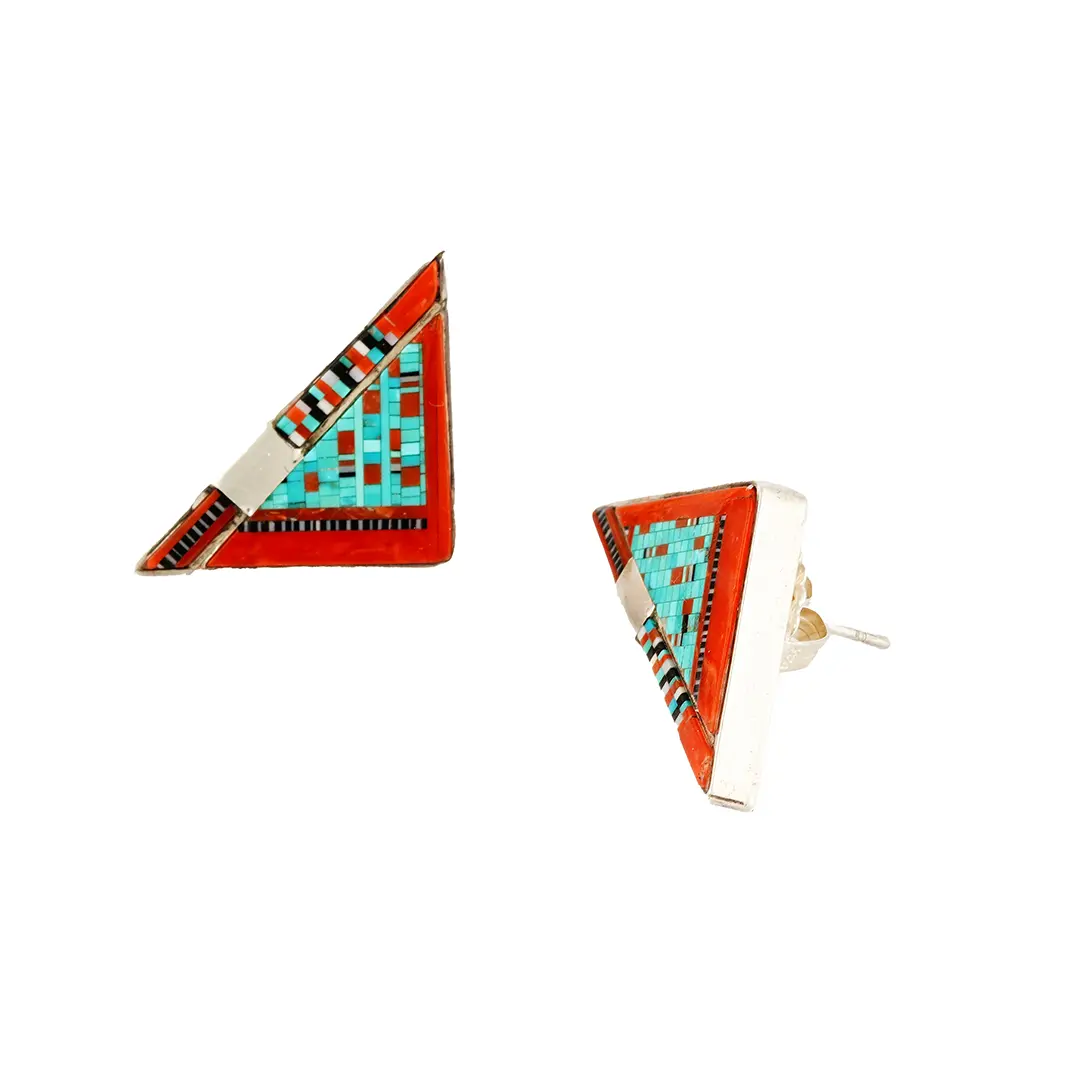
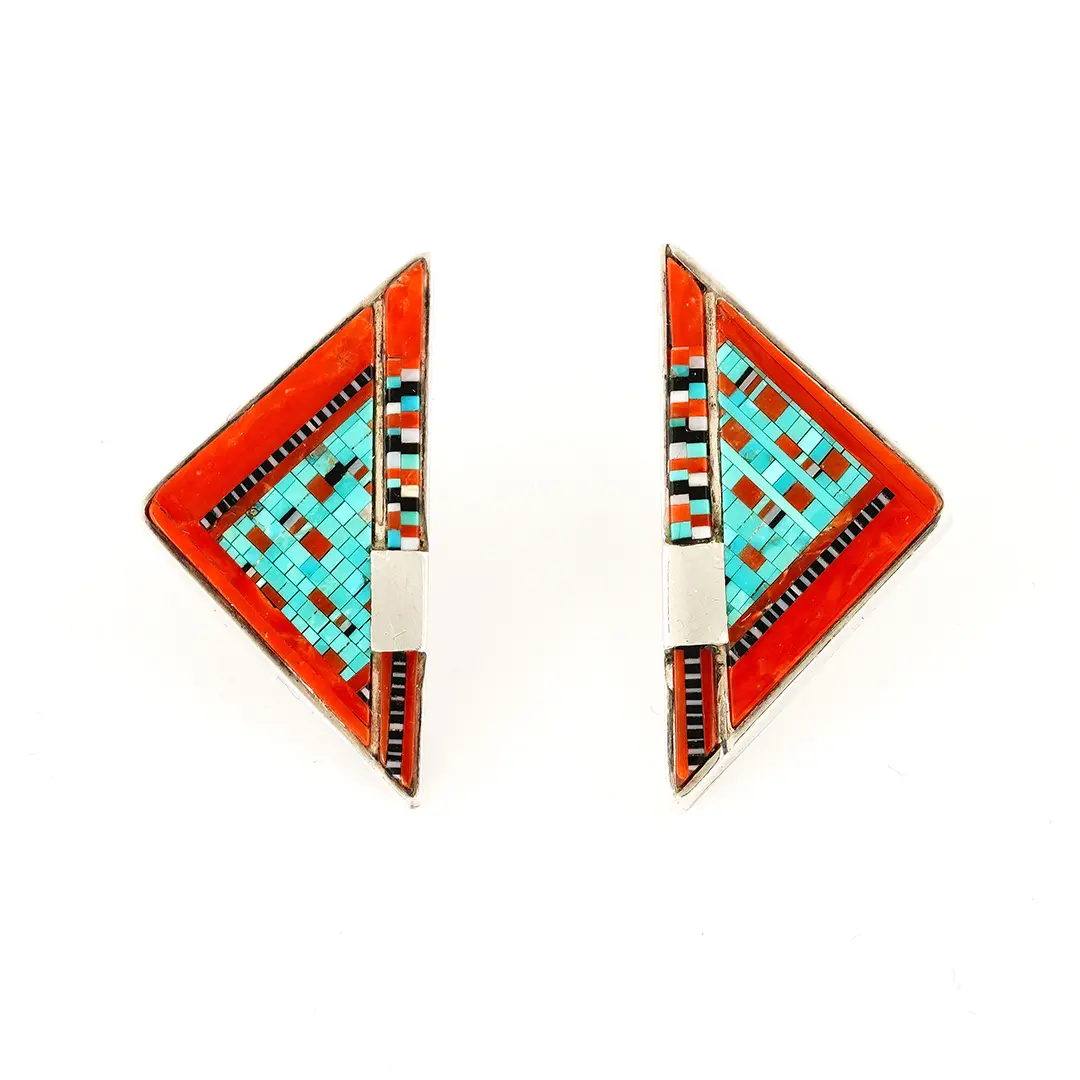
Carl and Irene Clark Silver Micro-Inlaid Earrings

$2,800.00

Carl and Irene Clark

These sterling silver earrings, made and dated 1984, are by Navajo jewelers Carl and Irene Clark. The Clarks started making jewelry in the mid-1970s, focusing on micro-inlay. Silver earrings are inlaid with coral, turquoise, jet, and mother of pearl. The Clarks sign these earrings on the back with their Hallmark. They are post earrings.


Dimensions: 1″ 3/16th L X 3/4th W

Earring Type: Post

In Stock

Lonesome Moon Studios by Jayden Starr

Jayden Starr · Lonesome Moon Studios

Raised in Coeur d’Alene, Idaho  ·  Hand-painted ceramics

Jayden Starr is a Western artist and the founder of Lonesome Moon Studios. With a BFA in Drawing, Painting, and Printmaking, she approaches clay as a painter, using wheel-thrown stoneware as a canvas for detailed, hand-painted imagery drawn from the landscapes, wildlife, rodeo culture, and history of the American West.

Working across functional ceramics and one-of-a-kind fine art pieces, Starr pairs traditional Western imagery with contemporary form and storytelling. Her work was recently exhibited in Unbridled at the A.R. Mitchell Museum of Western Art.

Read the full biography & interview →

Carl and Irene Clark are celebrated Navajo jewelers renowned for their innovative contributions to Native American jewelry, particularly through their groundbreaking micro-fine inlay technique. As a husband-and-wife team, their work beautifully blends traditional Navajo craftsmanship with contemporary design, setting them apart in the world of Native American art.

Carl Clark, a master silversmith, is known for his skillful use of silver, often incorporating stones like turquoise, coral, and onyx that hold deep cultural significance to the Navajo people. His intricate designs often feature Navajo symbols such as the Yei, spiritual figures representing the connection between the physical and spiritual realms. Irene Clark complements his work with her own expertise in design and inlay, contributing to the unique pieces they create together.

What truly sets the Clarks apart, however, is their pioneering work with *micro-fine inlay*. This technique involves the use of extremely small, precisely cut pieces of stone, meticulously set into sterling silver and gold. The inlays are so fine that they appear almost seamless, creating a smooth, continuous flow of color and texture. Their attention to detail and the precision required to craft these tiny inlay has garnered them widespread recognition.

The Clarks’ micro-fine inlay often incorporates geometric patterns, nature-inspired motifs, and traditional Navajo symbols, all of which are rendered with extraordinary skill and care. This technique elevates their jewelry, blending modern aesthetics with the cultural significance of their heritage. Their work pushes the boundaries of traditional Navajo inlaid jewelry, achieving a level of sophistication that has earned them a prominent place in the Native American art community.

Through their mastery of this delicate technique, Carl and Irene Clark have not only preserved and honored their Navajo roots but have also pushed the art form to new heights, creating jewelry that is both technically impressive and artistically exceptional.

What Is an Intaglio Etching? | Faust Gallery

What Is an Intaglio Etching?

An intaglio print is made from a metal plate where the image is cut into the surface. The word comes from the Italian intagliare, “to incise.” Ink sits in the cut lines, not on the surface, and a heavy press forces damp paper down into those lines to lift the ink out. Etching is the intaglio method that uses acid to do the cutting.

Few families are as closely tied to the process as the Lasanskys. Mauricio Lasansky founded the University of Iowa’s printmaking program in 1945 and spent his career pushing intaglio to a new scale, sometimes building a single color image from dozens of plates. Beginning in the early 1970s, his son Tomas Lasansky served as his printing assistant, learning hard- and soft-ground etching, engraving, aquatint, scraping, and burnishing at his father’s press. Mauricio’s grandson Diego Lasansky carries the same methods into a third generation, etching and engraving on copper in Iowa City—a single print of his can take months at the plate.

How an Etching Is Made

  • 01 The plate. The artist starts with a polished metal plate, usually copper.
  • 02 The ground. For etching, the plate is coated with an acid-resistant ground. A hard ground allows for crisp, controlled lines; a soft ground stays tacky and can capture drawn marks as well as the textures of materials pressed into it.
  • 03 The drawing. Using an etching needle, the artist draws through the ground, exposing bare metal wherever a line is to be etched.
  • 04 The bite. The plate goes into an acid bath. The acid bites into the exposed metal; longer bites generally produce deeper marks capable of holding more ink and printing more strongly.
  • 05 Tone. Tone can be created in many ways: through hatching, cross-hatching, stippling, and the accumulation of lines and marks; through textures transferred with soft ground; or through aquatint, in which fine resin dust is fused to the plate and bitten to create finely textured areas that hold ink. During printing, the artist can also selectively leave a film of ink on the plate’s surface, known as plate tone. Used alone or in combination, these methods can produce everything from subtle grays and atmospheric passages to dense blacks.
  • 06 Direct work. In addition to etching, images can also be worked directly into the plate using several techniques. Engraving uses a sharpened tool called a burin to cut controlled lines and grooves into the metal. Drypoint uses a pointed needle to scratch directly into the plate, raising a burr along the edge of the mark that holds ink and produces a characteristically soft, rich line. Scraping and burnishing remove or flatten existing marks and textures, allowing the artist to lighten, reshape, or erase areas of the image.
  • 07 Inking and wiping. Ink is worked into the recessed lines and textures of the plate, then the surface is carefully wiped with cloth and, often, the palm of the hand, leaving ink in the recessed marks while allowing the printer to control how much tone to leave on the surface of the plate.
  • 08 The press. Dampened paper is laid over the plate and run through an etching press under heavy pressure. The paper is forced into the recessed marks, transferring the ink and creating the characteristic embossed plate mark of an intaglio print.
  • 09 Proofs and editions. Every impression is inked and wiped by hand, one at a time. While developing an image, the artist prints proofs to see what is on the plate and to guide further changes. As the plate changes, these impressions document its successive working states. Once the image is complete to the artist’s satisfaction, an Artist’s Proof (A/P) may be made as a perfected impression of the finished plate. A numbered edition can then be printed, with each impression made to closely match the approved proof.

This is the historical tradition of editioned printmaking, but it is not the only approach. Some contemporary printmakers deliberately allow the plate, inking, wiping, or other elements to evolve throughout the printing process, producing a series of working states or unique impressions rather than a uniform edition.

By convention, the artist signs the finished work in the margin beneath the image and indicates its status—such as its number within an edition, Artist’s Proof (A/P), or state proof—as appropriate.

Color intaglio multiplies the work. Each color can require its own plate, and every plate must line up exactly on the same sheet.

How to Recognize an Intaglio Print
  • The plate mark. Look for a pressed rectangle around the image where the edge of the plate bit into the paper.
  • Raised ink. The ink stands slightly above the paper. Viewed at an angle, lines have relief you can see and, on an unframed print, feel.
  • Embossed paper. Deeply bitten areas push the paper into a subtle sculptural surface.
  • Small differences. Because every impression is hand-inked and hand-wiped, no two prints in an edition are exactly alike.
  • Signature and status. The artist signs in the margin beneath the image and marks the impression’s status: an edition number such as 12/50, A/P for Artist’s Proof, or a state proof.

An intaglio print is not a reproduction. It is an original work of art, printed by hand from a plate the artist made—a process the Lasansky family has practiced in Iowa City for three generations.

How to Measure a Painting for Your Space

Before purchasing a painting, measure the width and height of the wall area where you plan to place it. Also note any nearby furniture, windows, doorways, or architectural features that may affect how the work fits visually.

If the painting will hang above a sofa, bed, console, or mantel, measure the furniture as well. A common design guideline is to choose artwork that is about two-thirds to three-quarters the width of the furniture below it, though this can vary depending on the look you want.

Be sure to review the painting’s full dimensions, including the frame and depth, since these affect how much space the piece will occupy. To help visualize the scale, mark the artwork’s dimensions on the wall with painter’s tape.

When hanging the work, a common starting point is to place the center of the painting around 57 to 60 inches from the floor, adjusting as needed for furniture placement, ceiling height, and the proportions of the room.

If you are local to Santa Fe or Scottsdale, we are happy to assist with delivery and place the painting in your home so you can see how it looks in the space. This allows you to experience the scale, presence, and placement of the work before making your final decision.